Recipient of the Google.org Impact Challenge: AI for Science, Inria Chile receives US$2.5 million to accelerate an AI-powered digital twin of the ocean
Date :

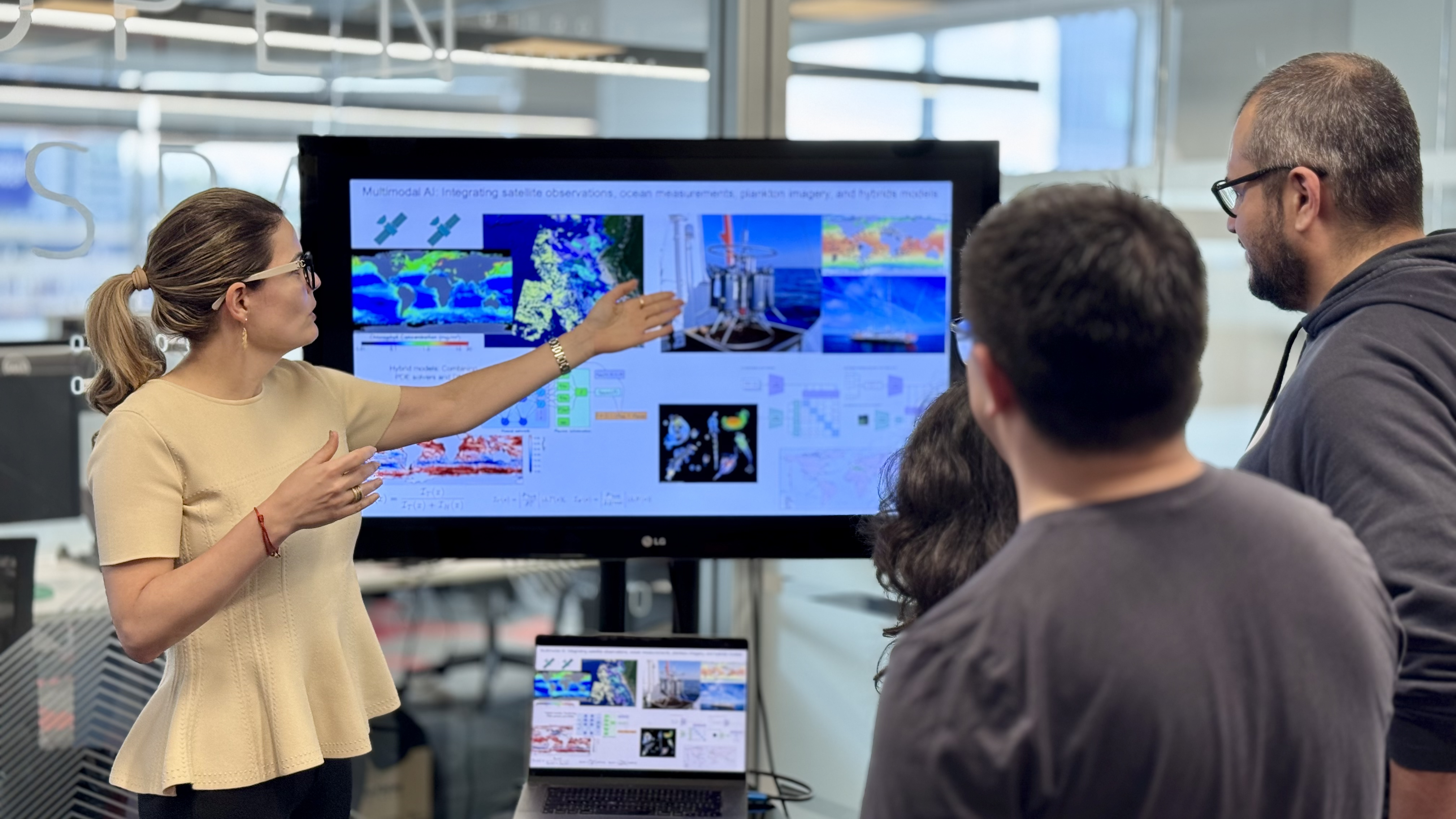
Inria, the French National Institute for Research in Digital Science and Technology, announced today that its center in Chile, Inria Chile, is a recipient of the Google.org Impact Challenge: AI for Science. Inria Chile will thus receive US$2.5 million to build a multimodal foundation world model of the ocean, the basis of a digital twin that will allow us to better understand Earth’s last great unknown.
Inria Chile is one of 17 organizations selected globally from more than 3,000 applicants across 30 countries to share an updated total of US$36 million in funding. It is the only institution from Latin America among the recipients, alongside leading universities and research institutions from around the world (Find out which projects won at https://goo.gle/gic-ai-science).
The ocean regulates the climate and feeds billions of people, yet it remains the least observed system on Earth, and its data – satellites, floats, biological and genomic surveys – remain scattered in mutually incompatible formats. Scientists still cannot reliably connect the warming and acidification of the ocean to their effects on marine life: harmful algal blooms, coral bleaching, the collapse of fisheries. MOFOMO (Multimodal Ocean Foundation Models for an Ocean Digital Twin) will build the first open multimodal foundation world model that learns at once from the ocean’s physical, biological and genomic observations, coupled with physics-based models for reliable and explainable forecasts.
In its first six months, supported by the Google.org Accelerator, MOFOMO will deliver several foundational elements:
By the end of the 36 months, it will have delivered:
MOFOMO (https://mofomo.inria.cl) takes over from OcéanIA, Inria’s research challenge on artificial intelligence for ocean science, led by Inria Chile for five years. In this new phase, Inria Chile will lead a multidisciplinary team spanning several institutions and three continents, with Inria project-teams in France and other scientific partners in Chile and French Polynesia.
Verbatim
AI for Science means, for us, designing a new generation of models: models that learn at once from the ocean’s physics, its biology and its genomes, from sparse and heterogeneous data and in keeping with the laws that govern it, so that we can ask what climate change will do to marine life before it happens. That is MOFOMO’s ambition and its research challenge: a digital twin of the ocean, built by physicists, biologists, oceanographers and computer scientists around the same model, and Google.org’s support lets us accelerate it: train at scale, release openly and bring forward the answers the ocean needs. That is what AI for good means to us. Being selected among 17 recipients out of more than 3,000 proposals is a recognition of the work carried out at Inria Chile over many years.
Director General of Inria Chile and Principal investigator of MOFOMO
Verbatim
I welcome this success, which illustrates how profoundly AI is transforming research on issues that are critical to our future. That Inria Chile is among the recipients of the Google.org Impact Challenge: AI for Science, alongside the world’s leading research institutions, shows what Franco-Chilean cooperation and the mobilisation of the entire artificial intelligence ecosystem can achieve in the face of a global challenge. This ambitious project builds on the Inria OcéanIA Challenge, whose full potential it will now realise, and I also want to salute all the work accomplished over the years.
Chairman and CEO of Inria
Verbatim
We’re at an extraordinary moment for science, as advances in AI open up new possibilities for discovery that were difficult to imagine just a few years ago. Inria Chile is bringing together AI and deep scientific expertise in ambitious, creative ways to address some of humanity’s most important questions. We’re honored to support their work as they apply AI to the ocean, the least observed system on Earth, to push the boundaries of scientific discovery and turn breakthrough ideas into real-world impact.
Director of Scientific Progress de Google.org.