Successful transfer: development of the L.O.V.E environment for the Vera C. Rubin Observatory concludes
Date :

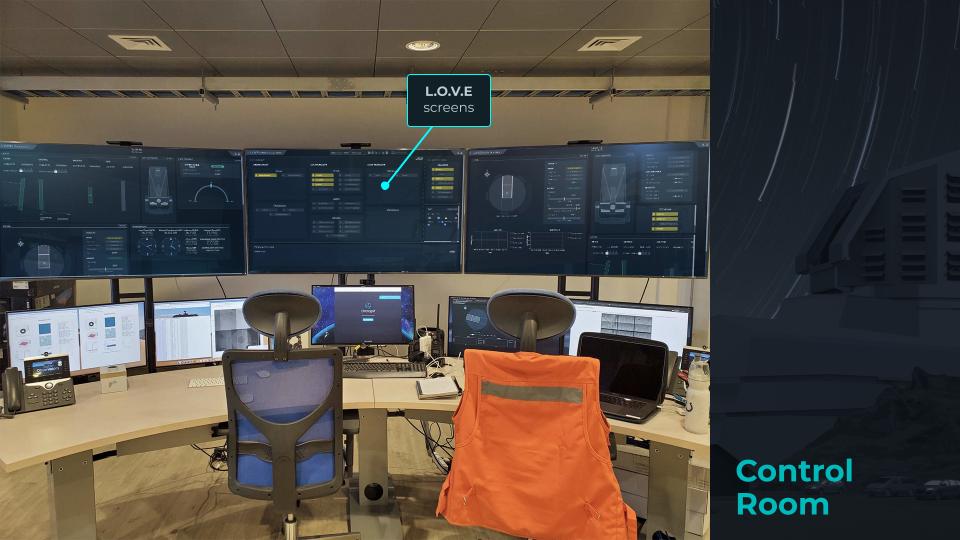
The Vera C. Rubin Observatory, equipped with a primary telescope designed to photograph the entire visible sky systematically, operates under a massive, highly complex distributed infrastructure.
Located on Cerro Pachón in northern Chile, the Vera C. Rubin Observatory was conceived to revolutionize the observation of the universe through a state-of-the-art telescope capable of systematically recording the southern sky. Its primary objectives include studying dark matter and dark energy, detecting small bodies in the Solar System, tracking transient astronomical phenomena, and creating the most detailed map of the Milky Way.
In this context, the Association of Universities for Research in Astronomy (AURA), the project’s overseeing body, commissioned Inria Chile to design and develop the user interface for the observatory’s control room. The project was part of the second phase of L.O.V.E. (LSST Operations and Visualization Environment), an initiative that continued the prior work by Inria Chile and Inria in developing a prototype for monitoring and controlling the observatory’s systems.
The L.O.V.E. project aimed to facilitate real-time monitoring of large volumes of information, providing astronomers and operators with a clear view of the observatory’s status to support decision-making. The L.O.V.E. environment directly impacts control room operations by providing specialized user interfaces and a visualization framework designed with high standards of human-computer interaction.
The primary technical benefit of this system is the substantial increase in Situational Awareness (SA) for astronomers and operators. Through intuitive interaction paradigms and interfaces tailored for transmitting complex real-time data, the system reduces the risk of human error, optimizes critical decision-making, and enables safe and efficient monitoring of variables.
The technology transfer process to the Observatory concluded at the end of 2023 and included the transfer of:
Core software components: Transfer of optimized source code repositories ready for production, along with integration tools and simulation systems.
Containers and infrastructure: Delivery of validated Docker images to ensure the portability of the environment.
Comprehensive technical documentation: Transfer of complete manuals and technical specifications for the architecture of each module, ensuring the Observatory’s full autonomy for technical maintenance.
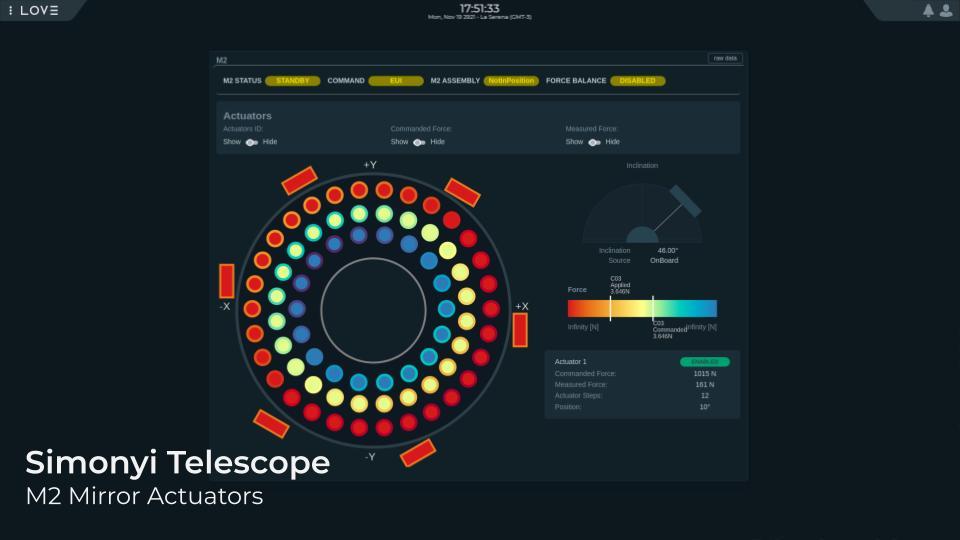
The project successfully addressed a high-complexity technological challenge: interacting in real time with massive distributed components and ensuring compatibility with the Observatory’s data management system. To solve this, the Inria Chile team developed advanced technical solutions and integrated cutting-edge technologies. Some of the developed components include critical telescope monitoring systems, advanced automation architecture, operational optimization, and environmental analysis.
The project’s development served as a high-competence platform for scientists and engineers, fostering practical learning in large-scale scientific visualization technologies.
The technical core was composed of a multidisciplinary team of about ten people, including scientists, engineers, software developers, international experts in human-computer interaction from the ILDA team at the Inria Saclay Center, and user experience (UX) designers.
As part of the strategy to integrate and train young talent, 5 students from the University of Chile and the University of O’Higgins were incorporated and directly trained in the project through internships during key phases. They assimilated development methodologies under international standards.
With the delivery of this open-source software environment to the Observatory’s repositories, the L.O.V.E. project developed by Inria Chile positions itself as the fundamental interactive core for efficiently operating one of the most ambitious cosmic exploration infrastructures of the 21st century.