Inria Chile Summer Internships 2026: University students complete their insertion into AI, computational ecology, and natural language processing initiatives
Date :

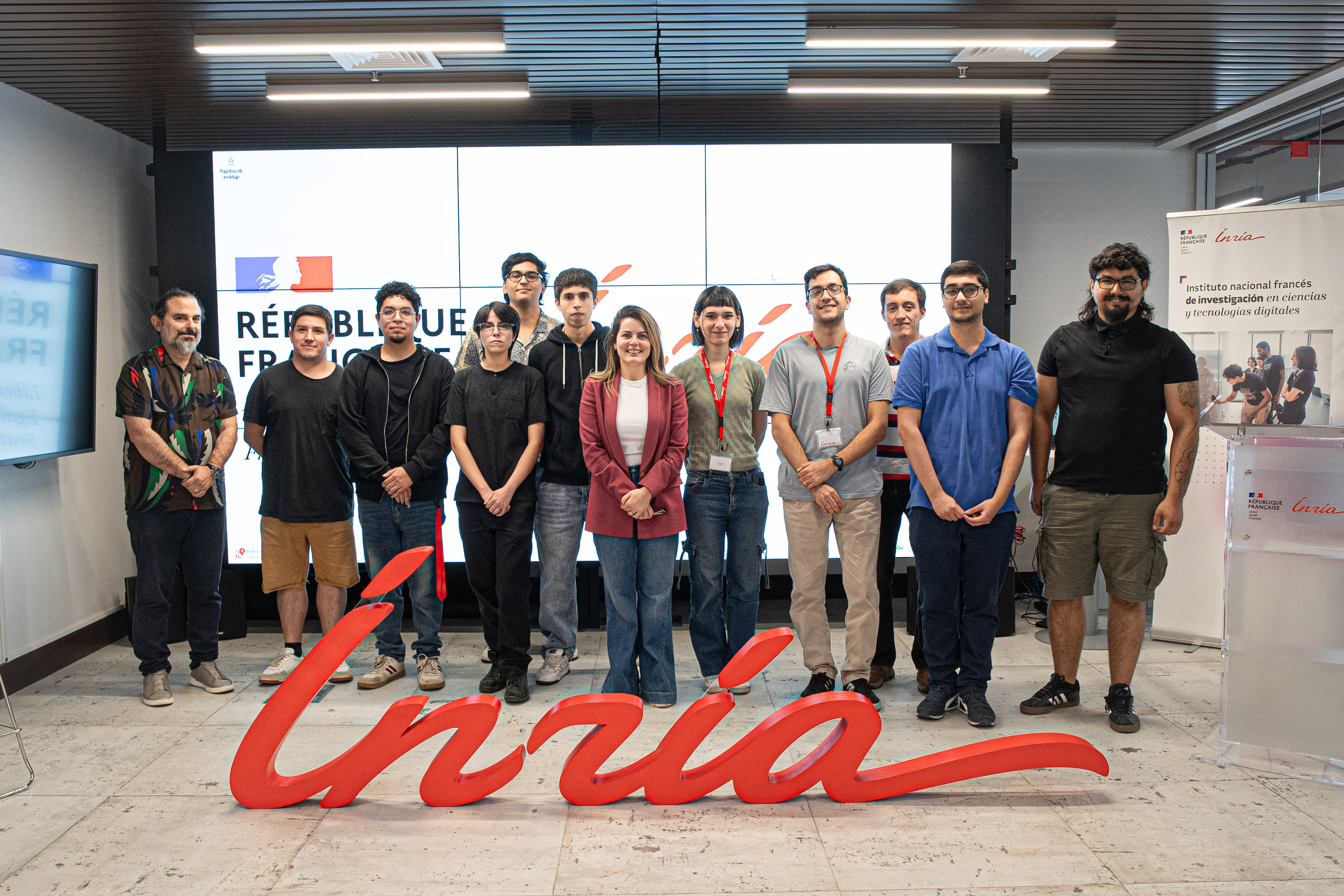
For two months, the students selected for the 2026 Program integrated into research projects and, upon completion, presented their progress and results. “They not only take away ideas but also learn to work collaboratively and to develop research in the field of digital sciences—often in artificial intelligence,” stated Nayat Sánchez-Pi, Director of Inria Chile and Director of the Franco-Chilean Binational Center on Artificial Intelligence.
For most participants, this internship represents their first real exposure to research. The experience goes beyond acquiring technical knowledge; it also involves learning to ask the right questions, work as a team, identify appropriate tools, and produce interpretable and useful results.
Verbatim
"What happens with the students is a very interesting virtuous circle. When they arrive, doors open that benefit both them and the organization. After this internship in Chile, many go through our Internship Program in France, connecting with international projects aligned with Inria Chile’s challenges. It’s a growth process that gives them the opportunity to pursue a PhD or formally join as researchers at the center"
Director of Inria Chile / Director of the Franco-Chilean Binational Center on Artificial Intelligence
This year, eight students from the Universidad de Chile, the Universidad Tecnológica Metropolitana and the Universidad Técnica Federico Santa María were selected to work on projects in artificial intelligence, computational ecology, and natural language processing.
Many of them joined the OcéanIA project, under the supervision of Inria Chile researchers, focusing on the following topics:
Sebastián Aguilera, a student of Civil Engineering in Computer Science at the Universidad de Chile, worked on the "Application of pre-trained LLMs with genomes to decipher the role of the marine microbiome."
Camilo Cerda, a student of Civil Engineering in Data Science at Universidad Tecnológica Metropolitana, focused on the "Application of pre-trained LLMs with proteomes to decipher the role of the marine microbiome."
Ignacio Díaz, a student of Civil Mathematical Engineering at the Universidad de Chile, achieved theoretical and numerical results to determine ecosystem fragility in the "Simulation and analysis of NPZ-T dynamics under CMIP6 scenarios."
Aurora Llanos, a student of Civil Mathematical Engineering at the Universidad de Chile, studied the understanding of the NPZ model, analysis of its theoretical basis, and simulations using real climate data within the same project.
Sebastián Vásquez, a student of Civil Electrical Engineering at the Universidad de Chile, worked on the "Application of state-of-the-art OOD detection techniques to plankton datasets."
In the Huemul project,
Adán Contreras, a student of Civil Computer Engineering at Universidad Técnica Federico Santa María, researched the topic "Developing a Spanish-Mapudungun Translator."
Meanwhile, Nicolás Garay, a student of Civil Mathematical Engineering at the Universidad de Chile, focused on the topic “Stability and convergence of evolutionary algorithms through continuous selection-mutation models,” and Maximiliano Valladares, also a student of Civil Mathematical Engineering at the Universidad de Chile, worked on “Models of chemical evolution of interstellar gas with selection dynamics and non-local operators” in astrocomputation.
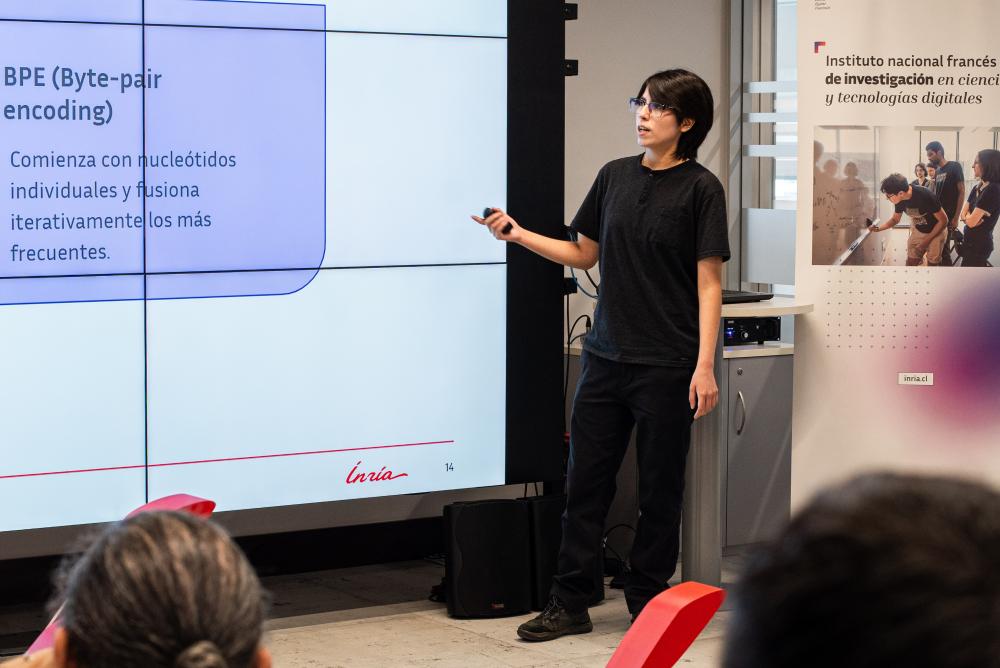
Verbatim
"I worked on a project involving genomic models (GLMs) and k-mers to predict the taxonomy of the Cox gene. I had to transform sequences into embeddings to classify them using an MLP and provide the corresponding prediction. It was an excellent work environment; even though there were biological concepts I wasn’t familiar with, my supervisor was always willing to explain them to me as many times as needed. I learned the importance of writing correct code from the start to avoid wasting resources, and I hope to continue applying what I’ve learned in working with language models and GPU parallelization.”
Student of Civil Engineering in Computer Science at the Universidad de Chile, intern in the OcéanIA project at Inria Chile, working on the topic "Application of pre-trained LLMs with genomes to decipher the role of the marine microbiome."
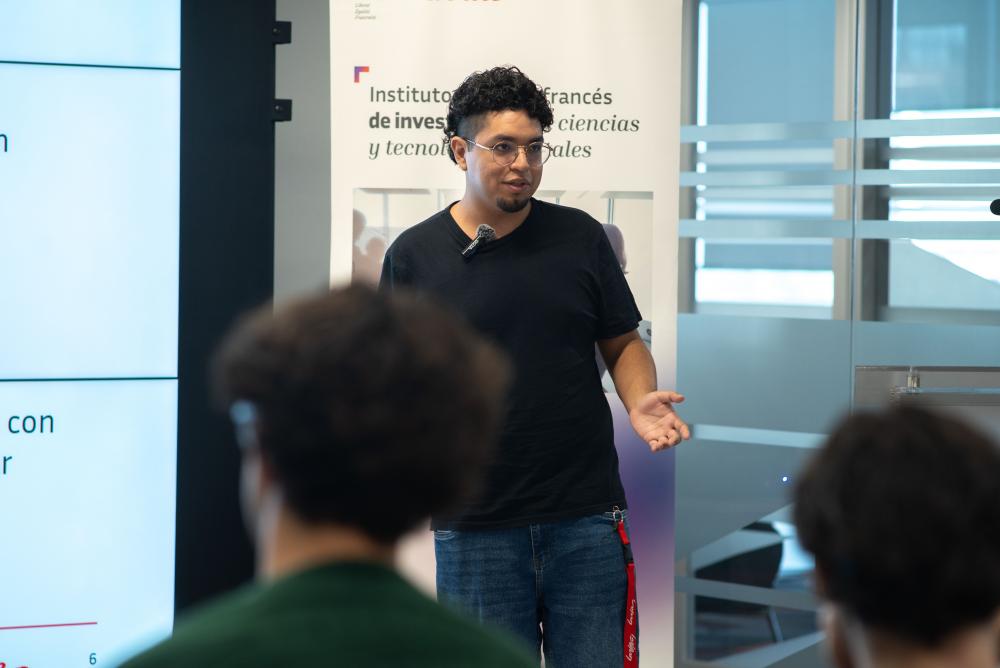
Verbatim
"My project involved developing a Spanish-Mapudungun translator. It was a wonderful experience where I learned how current translators work, the state of the art, and the Mapudungun language. As my first professional internship, it was a very welcoming work environment. I learned a lot about Machine Learning and really enjoyed the field of Natural Language Processing (NLP). I hope this learning will help me with my thesis and allow me to continue exploring this area."
Student of Civil Computer Engineering, Universidad Técnica Federico Santa María, intern in the Huemul project on the topic "Developing a Spanish-Mapudungun Translator."
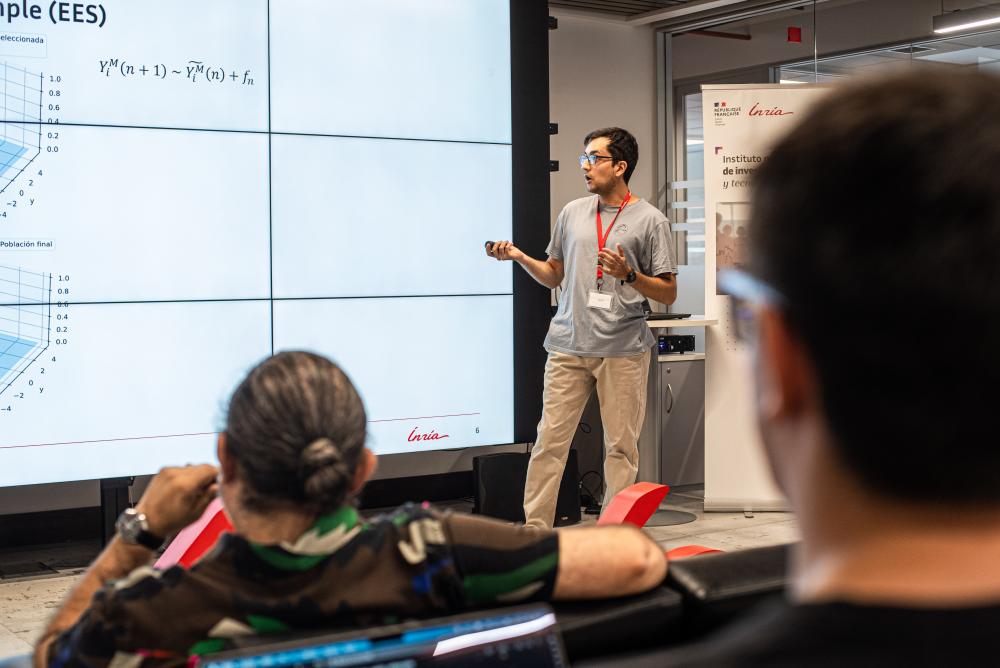
Verbatim
"I was at Inria Chile studying the convergence of evolutionary algorithms, which are very important in Machine Learning. We used advanced mathematical techniques to understand why these algorithms work. My experience was very positive; thanks to the support of my tutor and the entire team, we achieved interesting results that we hope to publish. I would like to continue delving into this new area I discovered during my internship, and if the opportunity arises, I would be interested in pursuing a master’s degree linked to Inria."
Student of Civil Mathematical Engineering, Universidad de Chile, intern on the topic "Stability and convergence of evolutionary algorithms through continuous selection-mutation models."
Verbatim
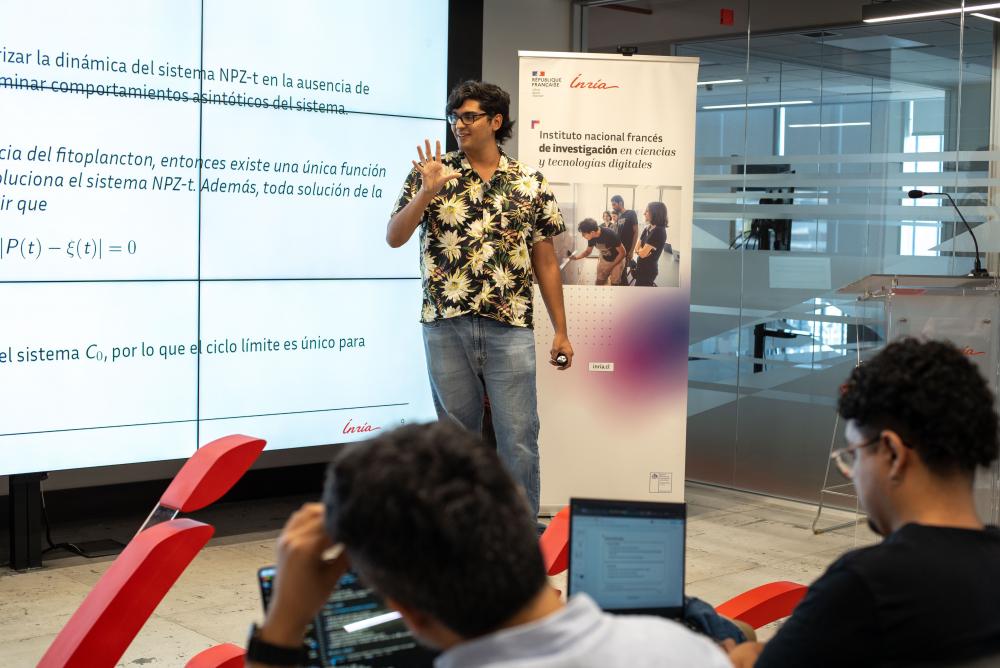
"During my internship at Inria Chile, I worked on the NPZ project for red tide forecasting. I obtained theoretical and numerical results that study the asymptotic regimes of a plankton model to determine ecosystem fragility. My experience was very welcoming; I learned a lot about how to approach a topic, conduct research, and identify the necessary tools. Most importantly, I learned how to produce results, interpret them, and make them useful for scientists specializing in the field. I hope to leverage this specialized knowledge to decide on my thesis topic and start a research career."
Student of Civil Mathematical Engineering, Universidad de Chile, intern in the OcéanIA project on the topic "Simulation and analysis of NPZ-T dynamics under CMIP6 scenarios."
Verbatim
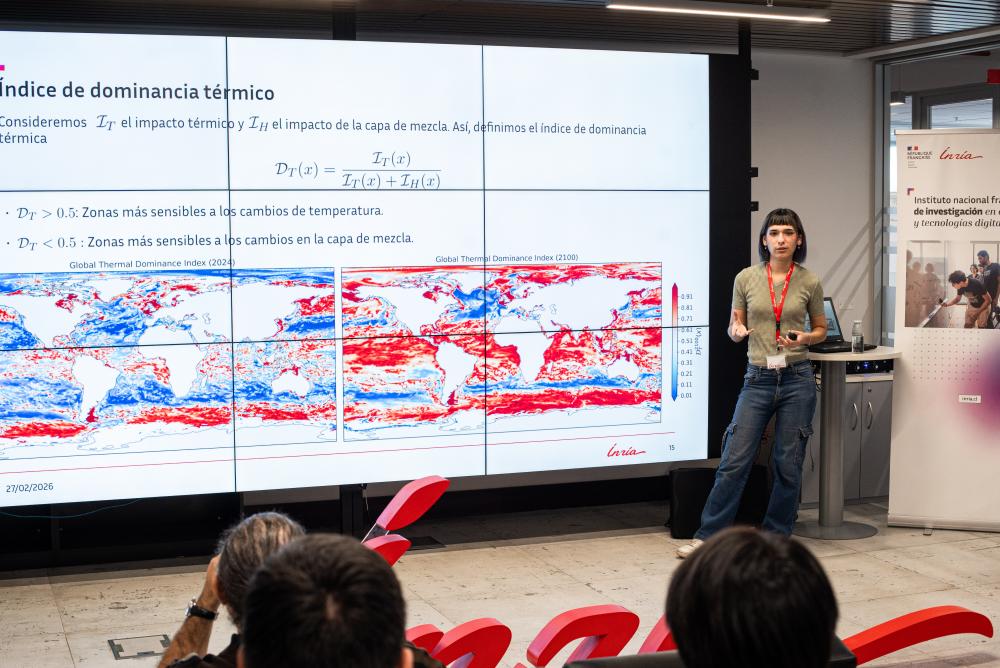
"I worked on the NPZ model, and my internship mainly involved researching the theoretical basis and running simulations with real climate data. I learned a lot about differential equations in non-autonomous systems, which are much more complex than those typically analyzed in engineering mathematics, and especially the challenge of working with them computationally. It was a very comfortable environment with a team always ready to help. This experience was my first introduction to academic research in topics I am very interested in, such as ecology and differential equations.
Student of Civil Mathematical Engineering, Universidad de Chile, intern in the OcéanIA project on the topic "Simulation and analysis of NPZ-T dynamics under CMIP6 scenarios."
Inria Chile has welcomed university students to its Summer Internship Program since 2012. In 2022, the program was formalized as an annual, structured call open to all universities in the country. Since then, the center has received applications from across Chile, establishing itself as a space for early training in digital sciences and artificial intelligence.
Over 50 students have participated in the program since its structuring, many of whom have continued their careers with Inria: conducting research internships at Inria France, pursuing PhDs, or joining as researchers at the center.
The program accepts applications from students at various universities in Chile, and its themes align with the priority areas of the Franco-Chilean Binational Center on Artificial Intelligence, established in 2026, which deepens scientific research collaboration between France and Chile.