Inria Chile analyzes the duality of AI at Cyber PUCV 2025 - Mission France: an essential defense tool and attack vector
Date :

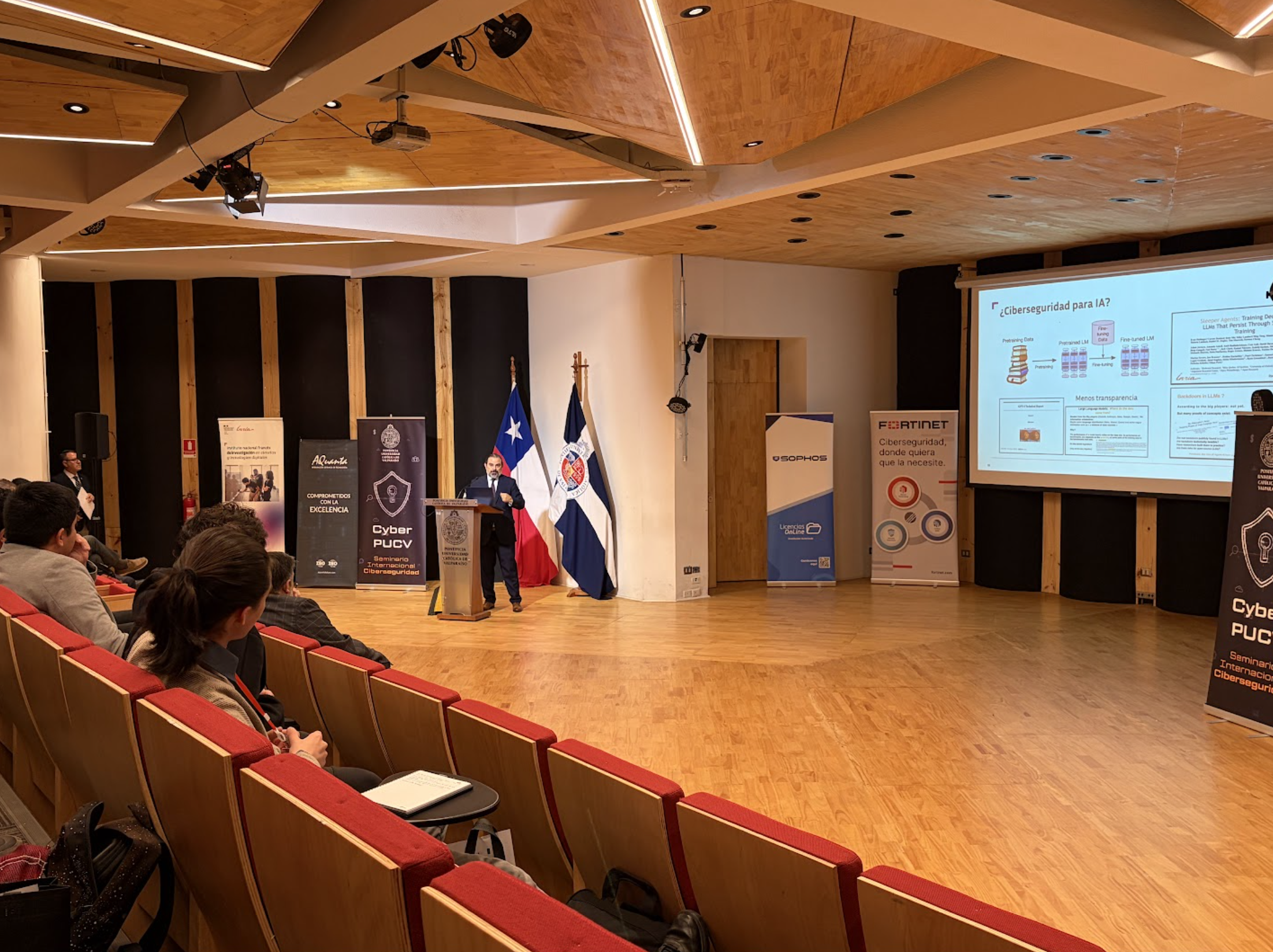
The School of Computer Engineering at the Pontificia Universidad Católica de Valparaíso (PUCV) organized the third edition of the International Cybersecurity Seminar, CyberPucv 2025, with France as the featured country. The event brought together national and international experts from academia, the public sector, and the private sector to address the main challenges in digital infrastructure protection, artificial intelligence (AI), and data privacy.
The event focused on analyzing the national cybersecurity landscape while also contributing to international collaborative workstreams. It highlighted the role of Inria Chile as a representative of French scientific excellence and a key player in shaping binational public policy in digital sciences and technologies.
Held in Valparaíso for the past three years during October—officially Cybersecurity Month in Chile—CyberPUCV aims to assess the state of cybersecurity in Chile and strengthen bilateral collaboration in this field. This year, France, represented by Inria Chile, took center stage.
In his opening remarks at the event, Guillermo Cabrera, Director of the School of Computer Science at the Pontifical Catholic University of Valparaíso, reiterated the university’s vision to become a regional and national benchmark in cybersecurity. Senator Kenneth Pugh of Chile highlighted France as a model for the country, noting that both Chile’s National Cybersecurity Policy 2023–2028 and the Cybersecurity Framework Law of April 2024—which established the National Cybersecurity Agency (ANCI)—draw inspiration from France’s experience.
This French leadership, which inspires Chile’s new institutional framework, is largely channeled through Inria. Inria’s Cybersecurity Program, operating on two main axes in support of French public policies—information security and system security—serves as a cornerstone of public-private collaboration in France. Inria manages research and technology transfer at the Cyber Campus, maintains industrial partnerships with key players such as Airbus, Thales, and Safran, and actively supports the tech startup ecosystem. Furthermore, it works closely with government agencies, including the Agence nationale de la sécurité des systèmes d'information (ANSSI), the French Ministry of Defense, and the Ministry of the Interior.
Inria es también parte del Instituto Nacional para la Evaluación y Seguridad de la Inteligencia Artificial (INESIA), un instituto creado en 2025 y encargado de la vigilancia de la inteligencia artificial en Francia. Dirigido por la Secretaría General de Defensa y Seguridad Nacional (SGDSN) en nombre del Primer Ministro y por la Dirección General de Empresas (DGE) del Ministerio de Economía, Finanzas y Soberanía Industrial y Digital de Francia, este instituto, permitirá aunar la acción de cuatro organismos públicos con competencias complementarias: la Agencia Nacional de Seguridad de los Sistemas de Información (ANSSI), el Laboratorio Nacional de Metrología y Ensayos (LNE), el Polo de Experiencia en Regulación Digital (PEReN) e Inria. El trabajo del instituto se centra en el análisis de los riesgos sistémicos en el ámbito de la seguridad nacional, el apoyo a la aplicación de la regulación de la IA y la evaluación del rendimiento y la fiabilidad de los modelos de IA.
In France, Inria leads the 'Digital Program Agency' (Agence de programmes dans le numérique – Algorithmes, logiciels et usages), where cybersecurity is one of its nine strategic programs. This specific initiative aims to strengthen fundamental research and technology transfer from public research to cybersecurity ecosystems, aligning with the priorities of France’s national strategy.
Inria is also part of the National Institute for the Evaluation and Security of Artificial Intelligence (INESIA), established in 2025 and tasked with overseeing artificial intelligence in France. Led by the General Secretariat for Defense and National Security (SGDSN) on behalf of the Prime Minister and the Directorate General for Enterprises (DGE) under the Ministry of Economy, Finance, and Industrial and Digital Sovereignty, INESIA unites the efforts of four public bodies with complementary expertise: the National Agency for the Security of Information Systems (ANSSI), the National Laboratory for Metrology and Testing (LNE), the Digital Regulation Expertise Hub (PEReN), and Inria. The institute’s work focuses on analyzing systemic risks in national security, supporting the implementation of AI regulation, and assessing the performance and reliability of AI models.
With Inria Chile’s participation in Cyber PUCV, its role in this strategic alliance was further strengthened. This partnership is exemplified by Inria Chile’s role as the operator of the Franco-Chilean Binational Center on Artificial Intelligence, connecting the ecosystems of both countries and addressing shared challenges, such as the intersection of AI and cybersecurity, and the development of secure AI.
Luis Martí, who represented Inria Chile at the event in Valparaíso, delivered a presentation titled Cybersecurity in the Age of Artificial Intelligence. In his talk, he explained that AI acts as an 'amplification/acceleration factor.' While it enables the digitization and optimization of production processes to operate reactively 24/7, this same speed causes errors to spread at an accelerated rate, with far greater impact.
He emphasized that this duality directly affects 'security, privacy, and well-being,' creating new risks. Martí also broke down the complex relationship between AI and cybersecurity into three key areas:
AI in Detection and Mitigation: How AI is used positively, such as through anomaly detection or causal inference.
AI as an Attack Vector: How AI can be exploited with malicious intent.
Cybersecurity of AI: The emerging challenge of protecting AI models themselves.
Additionally, he underscored the importance of addressing the inherent biases in AI models, noting that while biases are inevitable, they must be identified and corrected.