Inria Chile boosts Franco-Chilean research with two new AI projects running until 2028
Date :

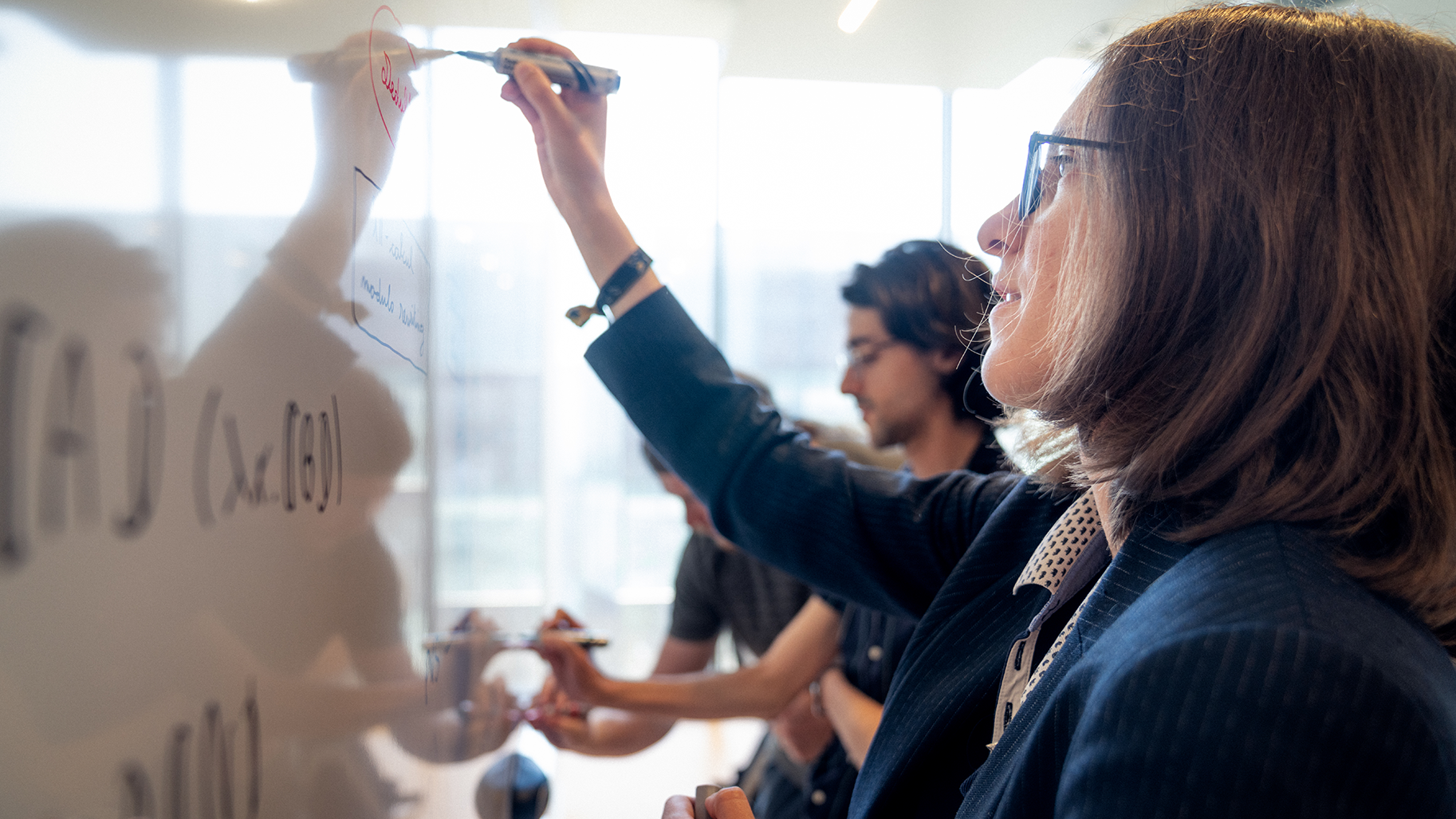
The Associate Teams program of Inria Chile aims to foster strategic alliances in digital sciences and technologies between France and Chile. Over a three-year period, these teams define shared scientific goals, promote researcher mobility to strengthen scientific development in the region, and support the integration of young researchers and students into excellence-driven research.
Since Inria arrived in Chile in 2012, Inria Chile has funded 39 Franco-Chilean research projects through this program. Currently, 10 Associated Teams are operational, driving collaboration between various Inria teams in France and Chilean academic institutions.
An Associate Team is a joint research project between an Inria project team and a research team abroad. For a period of 3 years, the partners jointly define a scientific objective, a research plan, and a program of bilateral exchanges. Since Inria arrived in Chile in 2012, 39 Franco-Chilean research projects in various areas of digital sciences and technologies have been funded by Inria under this program.
Currently, there are ten Associate Teams in operation, involving researchers from Inria centers in France, such as the Inria Centre at the University of Bordeaux, the Inria Centre at the University of Lille, the Inria Centre at Université de Lorraine, the Inria Paris Centre, the Inria Lyon Centre, and the Inria Centre at Université Côte d’Azur. Chilean institutions participating include the Universidad de Chile, Pontificia Universidad Católica de Chile, Universidad de Valparaíso, Universidad Técnica Federico Santa María, Universidad Austral de Chile, Universidad de Santiago, Universidad Adolfo Ibáñez, Universidad de O’Higgins, Pontificia Universidad Católica de Valparaíso, and Universidad de Concepción.
The RAISGATE project (Reliable Artificial Intelligence via Stochastic Game Techniques) aims to bring together experts in applied probability and operations research to advance the theory of dynamic Stackelberg games. This theory enables modeling scenarios where a "defender" must anticipate the actions of one or more "attackers" in environments that evolve randomly.
Practical Applications: The team will develop tools for wildfire prevention and the protection of distributed learning systems against malicious data injection.
Expected Outcomes: Algorithmic advancements will be incorporated into the Marmote software and integrated into a decision-support tool for wildfire management.
This initiative is institutionally led by the NEO project team at the Inria Centre at Université Côte d'Azur and the Universidad de O'Higgins. The coordinators are Alain Jean-Marie (Inria) and Víctor Bucarey (Universidad de O'Higgins). The project also benefits from collaboration with the Center for Environmental Economics of Montpellier (CEE-M), INRAE, the COATI project team at Inria, and the Universidad de Chile.
Under the name MULTIMEDIAT (MULTImodal MEdiation of Debates with conversatIonal AgenTs), this project explores how to empower socially intelligent agents by modeling non-verbal phenomena to mediate political debates.
Socially Aware AI: The team will develop mediator agents based on large-scale language models (LLMs) capable of analyzing arguments, detecting stances, and guiding discussions toward consensus using argument mining and conflict resolution strategies.
Empathetic Interaction: The project integrates speech signals, facial expressions, and gestures into Embodied Conversational Agents (ECAs). Using transformer-based fusion methods and information theory, these agents will be able to interpret and generate socially coherent behaviors to facilitate constructive interactions between humans and AI.
The leading institutions are the ALMAnaCH project team at the Inria Paris Centre and the Universidad de Chile. The project is coordinated by Chloé Clave (Inria) and Valentin Barrière (Universidad de Chile), with collaboration from the National Center for Artificial Intelligence (CENIA).